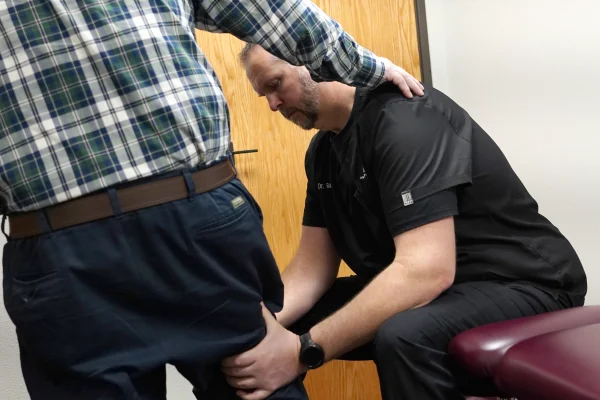
If you’ve been told your knees are “bone on bone” and surgery is your only option, you’re not alone — and you may not have heard the full story. This is a real case from our knee restoration program at Accelerated Chiropractic in Morris, MN, documenting what happened over approximately 3 months for a 64-year-old woman from Fergus Falls who had been living with knee pain since her teenage years — and hadn’t received any treatment for it in nearly five decades.
No injections. No surgery. No medication added. Just measurable results — tracked at three points across her care plan.
Who This Patient Is
A 64-year-old woman from the Fergus Falls, MN area came to our clinic for an initial evaluation. She described her knees as “crappy” — her word — with problems dating back to her teenage years. She’d had a knee procedure at 17 to remove bone fragments and damaged cartilage — and then spent the next 46 years without any further treatment. No physical therapy. No cortisone shots. No knee brace. No follow-up. She had tried an over-the-counter supplement (Ultimate Repair V) that she felt provided some relief, but nothing had addressed the underlying problem. Cold weather, stairs, and kneeling made it worse. Going down steps backwards was the only thing that helped.
Her pain averaged a 4 out of 10. Her knee problems were interfering with hobbies, exercise, walking, lifting, and work. But what she said she wanted most was simple: kneel on the floor, climb stairs without thinking about it, and keep up with her grandkids.
On X-ray, both knees showed Stage 1 degenerative joint disease (DJD) — early-stage arthritis with measurable cartilage and joint changes.
Baseline Measurements — Day 1
Before any treatment began, we ran a full functional evaluation. Every test is scored 0–10, where 0 means no difficulty and 10 means extremely painful or impossible.
Functional Test Scores (Day 1, Pre-Treatment)
Range of Motion (Day 1, Pre-Treatment)
That last number is worth pausing on. After a single trial treatment on Day 1, she reported feeling 30–40% better before she left the building. Her right knee ROM improved from 117° to 119° in that same session. This is a common early indicator that a patient will respond well to the program.
Progress Evaluation — 6 Weeks In
At the mid-program progress exam, the numbers had moved significantly — particularly on the right side, which had been the more limited knee at baseline.
Functional Test Scores (6 Weeks)
Range of Motion (6 Weeks)
What She Said at 6 Weeks
On her self-reported progress form, she rated improvement across every area she came in struggling with:
- Knee pain overall: 70% improved
- Work: 60% improved
- Kneeling: 60% improved
- Stairs: 60% improved
- Playing with grandkids: 60% improved
She also checked better balance and stability, and improved ability to be more active. She rated her results as Excellent and said her quality of life had improved. She was following her home therapy protocol pretty close to exactly as directed.
Exit Evaluation — 3 Months
At the final exam, the trajectory held. ROM continued to improve on the right side. Functional scores remained substantially lower than baseline across the board.
Range of Motion (3 Months)
What She Said at 3 Months
On the exit progress report, she marked improvement across all five areas she originally listed:
- Knee pain: 50–60% improved
- Kneeling: 50–60% improved
- Work: 50–60% improved
- Stairs: 80% improved
- Playing with grandkids: 50–60% improved
She also reported better balance and stability, ability to be more active, and less lower back and hip pain — a common secondary benefit we see with knee restoration patients. Her quality of life had improved. She rated her results as Excellent.
When asked how our results compared to other treatments she’d received for this condition, she marked N/A — because aside from a knee procedure nearly five decades earlier, she’d had no other treatment to compare it to. This program was the first time anyone had addressed her knee condition in a meaningful clinical way since she was a teenager.
The Numbers Side by Side
Here’s a clean look at where she started versus where she finished:
Range of Motion
Right Knee: 117° → 123° (+6° net gain; reached 126° at mid-program)
Left Knee: 125° → 126° (stable with noted cramping resolved by exit)
Functional Test Improvement (Waddle Test — most demanding)
Left: 8/10 → 4/10 | Right: 7/10 → 4/10
Self-Reported Activity Improvement at Exit
Stairs: 80% | Knee Pain: 50–60% | Kneeling: 50–60% | Work: 50–60% | Grandkids: 50–60%
Overall Patient Rating
Excellent — with improved quality of life, better balance, and more active daily life confirmed at exit exam.
Why This Matters for Patients in Fergus Falls and West Central Minnesota
This patient drove from Fergus Falls to Morris — about 65 miles — for every visit. That’s not unusual for our clinic. We regularly see patients traveling from Alexandria, Willmar, Brainerd, St. Cloud, and across the region because our Knee Restoration Program is one of only a handful available in Minnesota.
For people in this part of the state, the typical path for bone-on-bone knee arthritis looks like this: primary care refers to orthopedics, orthopedics recommends cortisone shots, shots stop working, and eventually a knee replacement is scheduled. That path works for some people. But a lot of patients aren’t candidates for surgery, aren’t ready for it, or simply don’t want it.
This case shows what’s possible when you address the underlying joint mechanics and circulation rather than masking pain or replacing the joint. A 64-year-old woman with Stage 1 DJD in both knees who hadn’t received any knee treatment in 46 years came in at 4/10 pain and left — 3 months later — with 80% improvement in stair function and a quality of life she described as genuinely improved.
Is the Knee Restoration Program Right for You?
This program isn’t for everyone, and we’re upfront about that. It works best for people who:
- Have knee pain that’s been limiting their life for months or years
- Have been told they’re bone on bone or have early-to-moderate arthritis
- Want to avoid or delay surgery
- Are willing to commit to a home therapy protocol between visits
- Are not current candidates or are not ready for knee replacement
If that sounds like you or someone you know in the Fergus Falls, Alexandria, Willmar, or greater west central Minnesota area, the first step is a $79 new patient assessment. We’ll review your X-rays or order them if needed, run the same functional tests documented in this case study, and give you an honest answer about whether you’re a candidate for the program.
Ready to Find Out If You’re a Candidate?
Schedule your $79 Knee Assessment at Accelerated Chiropractic in Morris, MN. No obligation. No pressure. Just answers.
Frequently Asked Questions
How far do patients travel for the Knee Restoration Program?
Many of our knee patients travel 60–90+ miles. We regularly see patients from Fergus Falls, Alexandria, Willmar, Brainerd, and St. Cloud. The drive is worth it for a lot of people because this program simply isn’t available in most communities.
Does this work for bone-on-bone arthritis specifically?
Yes. Many of our best results are with patients who have Stage 1–3 degenerative joint disease. The patient in this case study had Stage 1 DJD in both knees. Results vary based on severity, age, weight, and compliance with the home protocol, but early-to-moderate arthritis is exactly who this program is designed for.
What does the $79 new patient assessment include?
It includes a full consultation, functional knee testing (the same tests documented in this case study), X-ray review, and a frank conversation about whether you’re a candidate for the program. If you’re not a good fit, we’ll tell you that.
How long does the program take?
The patient in this case study completed her program in approximately 3 months. Most programs run 8–12 weeks depending on severity and how quickly a patient responds. You’ll have a clear plan and timeline from day one.
Do I need a referral from my doctor?
No referral is needed. You can schedule directly with our office. We do communicate with your primary care physician with your permission — which this patient chose to do — to keep your care team informed.
What if I’ve already had a cortisone shot or physical therapy?
Prior treatment doesn’t disqualify you. In fact, many patients come to us after other approaches haven’t provided lasting relief. We’ll evaluate your case individually and give you an honest assessment.
Is this covered by insurance?
The knee restoration program is not billed to insurance at this time. We’re transparent about fees from the start. Many patients find the out-of-pocket cost significantly less than the co-pays, time off work, and recovery involved in surgery.
Accelerated Chiropractic & Natural Healing Center
707 Atlantic Ave, Morris, MN 56267